

The Business Impact of XR Learning – Metrics That Matter (Part 3 of 3)
Sean Keogh · 2 Jul 2025 · 2 min read
XR Integration Strategies
XR technologies provide clear, measurable benefits across the board
Moving Beyond the Wow Factor
Virtual reality is no longer a novelty. Organisations adopting XR are asking harder questions—and rightly so. What’s the return on investment? How does it compare to traditional methods? Which KPIs matter most?
This final piece in our immersive learning series examines XR learning impact from a performance and business perspective. What is measurable, what is meaningful, and how can you build a clear case for investing in immersive training?
The Metrics That Matter Most
Time-to-competency
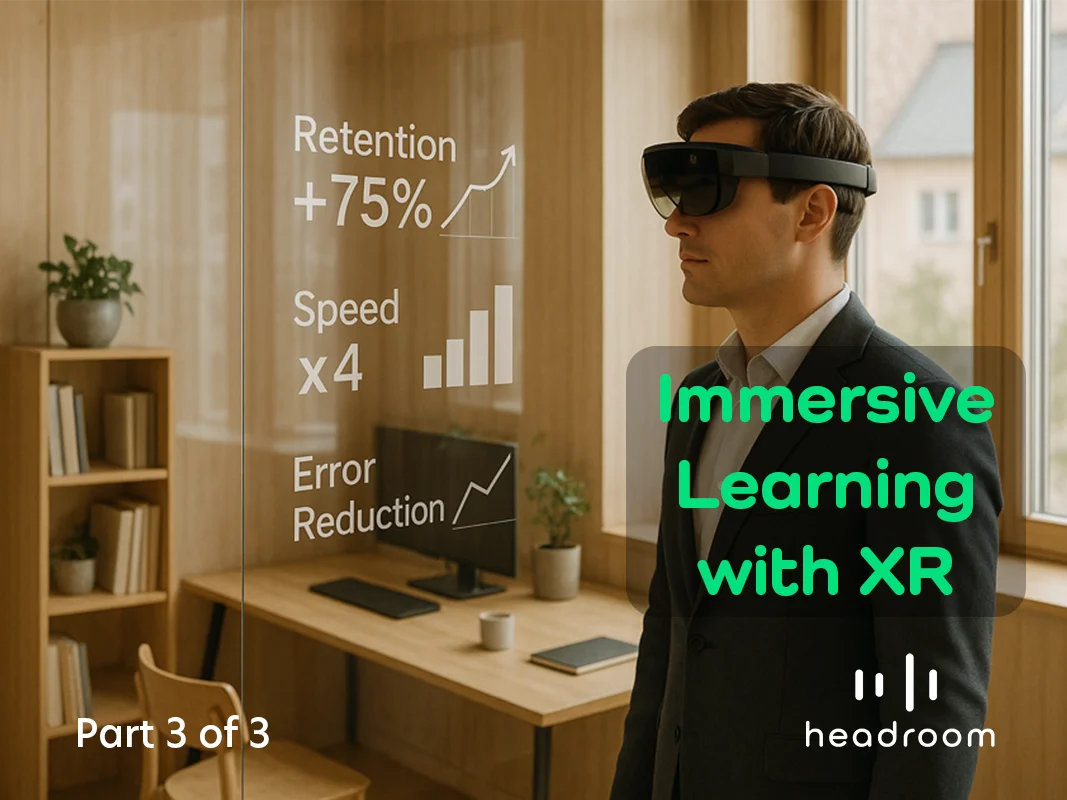
Employees using XR learn up to four times faster than in classroom environments, even when accounting for the time required to onboard with headsets (PwC).
Knowledge retention
Learners retain up to 75–80% more information with VR-based learning than with traditional methods (PwC).
Error reduction
In high-stakes environments such as healthcare, XR-based procedural training reduces onboarding errors while improving skill acquisition and confidence (WEF).
Engagement and confidence
VR training has been shown to increase learner confidence by up to 275% while improving focus and engagement during sessions (PwC).
Industry Examples of ROI for XR Learning
Retail: VR customer service training led to a 20% increase in mystery shopper scores, showing measurable improvements in customer-facing interactions (Accenture).
Logistics: XR onboarding reduced new-hire training times by up to 40% while maintaining operational quality (Accenture).
Healthcare: XR simulations for surgical and procedural training have resulted in fewer errors and faster readiness for new healthcare professionals (WEF).
Sales: Retailers using AR/VR tools for immersive product demos and training reported up to 20% increases in conversion rates (ResearchGate).
Building the Case for Leadership
To secure buy-in for XR, emphasize:
- Outcomes over novelty: Focus on data, not demos.
- Scalability: XR modules can train many learners efficiently.
- Alignment with business goals: XR supports talent strategies and operational excellence.
Conclusion: Immersive Learning as a Business Strategy
XR, when designed and measured effectively, is more than a training tool. It accelerates onboarding, enhances skill development, reduces errors, and directly supports retention and performance goals.
This concludes our three-part series on immersive learning with XR. If your organisation is ready to align XR learning with measurable outcomes, headroom can support you in building the case and the implementation.
About This Series
This article is part three of our three-part series on immersive learning with XR. In the first piece, we explored how extended reality supports the full employee lifecycle—from onboarding to continuous development. In the second part, we examined what makes modular XR learning effective, focusing on design principles that drive impact. In this final part, we reveal how to measure the real business value of XR training, with clear performance metrics and ROI examples.