

Meta VR Glasses: Could This Finally Be VR People Will Actually Wear?
Sean Keogh · 24 Sept 2026 · 5 min read
Technology Reviews
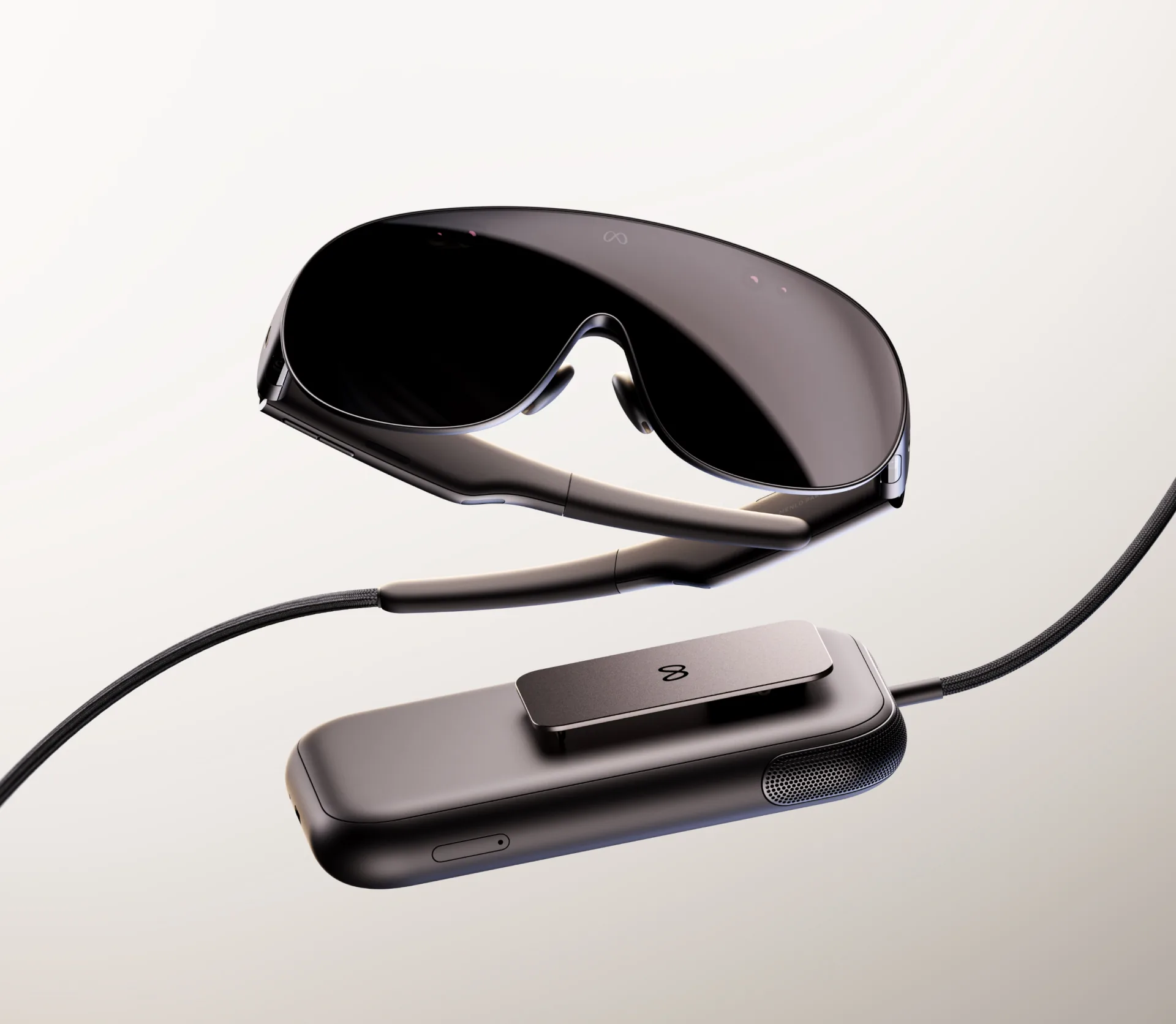
Meta VR Glasses: 100 grams on the face, the heavy lifting in a puck (Photo: Meta)
Plenty of VR headsets have promised to change how people work. Most of them ended up in a cupboard, and the reason was rarely the software. It was the thing itself: heavy, warm, hair-flattening, and faintly ridiculous to wear in front of colleagues.
Which is why Meta’s announcement at Connect this week caught our attention. Meta VR Glasses weigh around 100 grams, are shaped like glasses rather than a headset, and ship in spring 2027 for $1,299.99. On paper, they do most of what a full VR headset does.
A note before we start: we haven’t tried them. What follows is based on Meta’s announcement, its published specifications and the first hands-on reports from Connect. We’ll write again once we’ve had them on.
Vision Pro ideas, without the glass and aluminium
Look past the branding and much of this will feel familiar to anyone who has used an Apple Vision Pro. Sharp micro-OLED displays. Colour passthrough, so the room stays visible. An interaction model built on looking at things and pinching your fingers, with no controllers required. Photorealistic avatars for video calls, which Meta calls Hologram and Apple calls Personas. Even the external pack, which is fast becoming standard for any headset that takes comfort seriously; Meta simply goes further and moves the chip, memory and storage into it alongside the battery. Three hours of video playback from that puck is already more than a Quest 3 or a Vision Pro manages.
Legs, apparently, are back too. Zuckerberg revived the old joke on stage, and we wrote about Meta’s leg problem back in October 2022. Four years on, Hologram is the more useful progress: a face-tracked avatar that joins WhatsApp or Zoom calls, so colleagues on an ordinary laptop see you rather than a cartoon.
What Meta has done differently is the part Apple never dared to. Vision Pro is a beautiful object, but it’s a heavy one, and a good share of that weight is the glass front and aluminium frame. You feel it after an hour. Meta has pointed its enormous R&D budget at the opposite problem: stripping the thing on your face down to the bare minimum. Just imagine what Vision Pro might have been if Apple had been willing to let go of the glass.
Judging by the first reports, the result is something you might actually be willing to wear in a meeting.
Why that matters for work
For the work we do at headroom (immersive training, workshops, hybrid collaboration) the headset has always been the bottleneck. A facilitator who can’t see the room. Participants who take the device off every ten minutes. A board member who tries it once and politely hands it back.
Glasses with open sides and good passthrough could change that. You stay in the room with your colleagues, you can glance at your notes, and you might even forget you’re wearing them. And because the glasses run the same operating system as the Quest 3, with Meta promising support for the existing Quest library, organisations that have already built content shouldn’t have to start again. As we argued in our piece on Valve’s Steam Frame, continuity is what turns a pilot into infrastructure.
The questions we want answered
That’s the premise, and we like it very much. Whether it survives contact with a real working day is another matter.
The first question is light. A headset works partly because it seals you off from the room; glasses with open sides don’t. Meta offers light blockers, but early testers noticed the image lose some punch to ambient light without them, and at least one demo took place in a dimmed room. In a bright office or a sunlit training centre, that could be the difference between immersive and washed out.
The second is immersion itself. The field of view is 70 degrees horizontally, against 110 on the Quest 3, and every hands-on report noticed it. For films and floating screens that may not matter. For training that depends on peripheral vision, such as safety simulations or spatial walkthroughs, it very well might. Immersion has always come partly from the seal and the wide view. Meta is betting it can get there with pixels instead of a clamp.
The third is what the “computer” actually is. Part of the answer is clear: the puck is a standalone machine with a Snapdragon chip, running the same operating system as the Quest 3, so Quest apps run on it directly. Meta also says the glasses can connect to a PC or Mac, and Engadget’s reviewer saw a remote desktop demo. What we don’t know yet is how far that goes. Is it a proper set of virtual monitors driven by your own laptop, the way Vision Pro handles a Mac, or a remote desktop in a floating window? Can you plug the glasses straight into a computer, or does everything route through the puck? And does it stream PC VR? For most organisations, glasses that act as a display for the Macs and PCs people already use would be far more valuable than yet another app ecosystem to manage.
Then come the practicalities. Fit looks fiddly, with a small sweet spot and a sizing choice at purchase. There’s no European price yet. And we’ve seen nothing so far on device management, hygiene or shared use, which is where enterprise deployments tend to live or die. Every impression to date comes from demos of twenty or thirty minutes on pre-release hardware.
Our take
Meta has taken much of what made Vision Pro impressive and put it into something that looks like it belongs on a human face. If it delivers, it’s the most important step towards everyday VR we’ve seen in years. If it doesn’t, it will still have shown everyone else where the bar should sit.
We want to try it as soon as we possibly can. Until then, judgement reserved.
Spring 2027, then. We’ll bring our own light meter.