

How Apple Vision Pro Is Elevating Virtual Reality Collaboration
Sean Keogh · 28 May 2025 · 2 min read
XR Integration StrategiesWe’ve spent the last few years making a simple argument: virtual reality collaboration beats video conferencing—hands down.
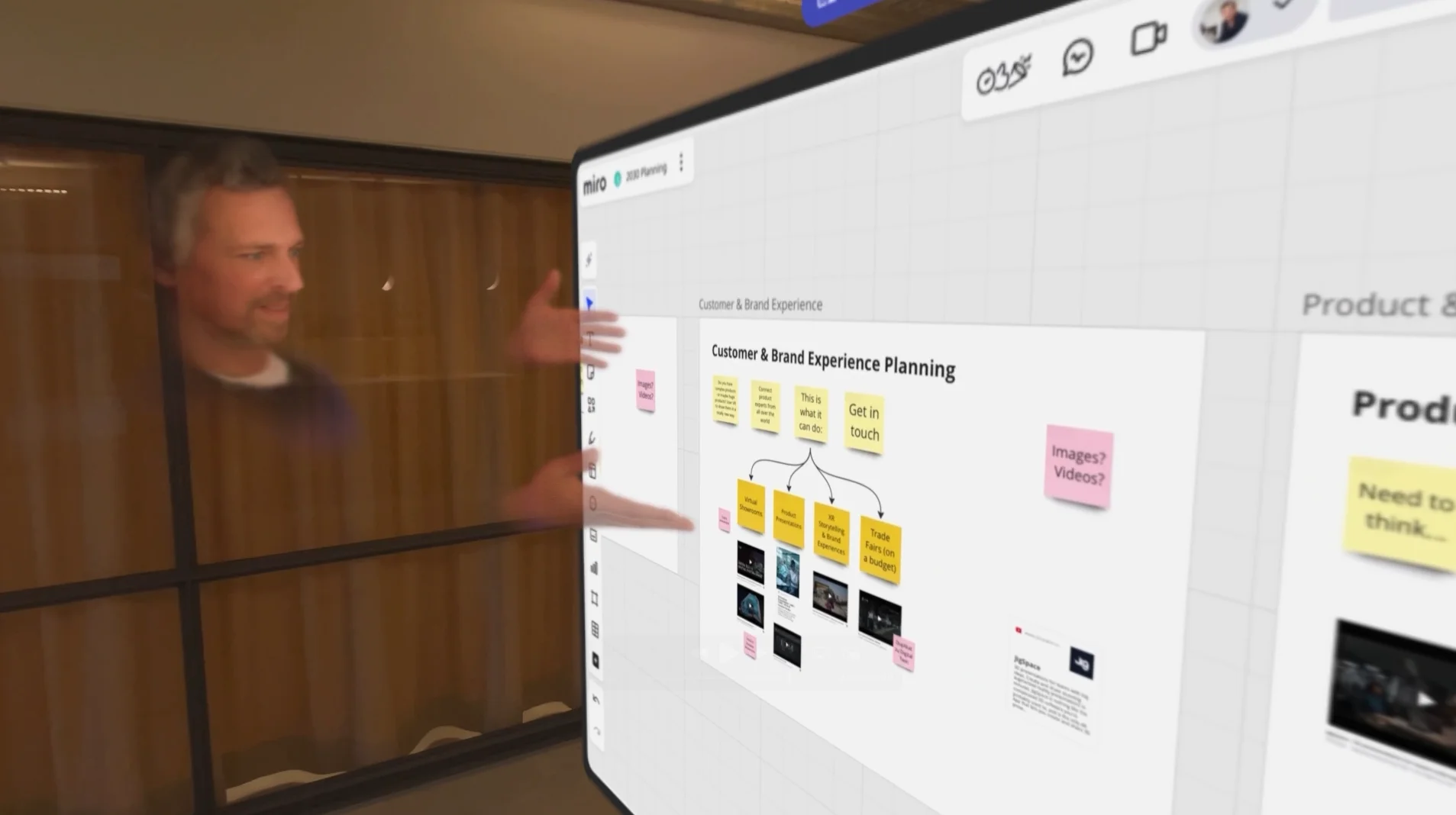
Why? Because meeting in VR isn’t just about hearing and seeing; it’s about being there. Unlike flat video calls, where conversation happens in boxes on a screen, VR meetings offer a spatial sense of presence. You can turn to someone next to you, gesture toward shared content, and read body language more intuitively. It feels like a meeting, not just a transmission of words and faces.
That said, even we’ll admit there were sticking points. Some users found the avatars too simplistic. Others felt the hardware wasn’t quite ready for prime time. But despite that, the benefits of VR collaboration—true engagement, more natural interactions, reduced fatigue—kept pushing the technology forward.
Now, something has shifted.
Enter Apple Vision Pro.
This isn’t just another headset; it’s a reset. With ultra-realistic “Personas” (Apple’s term for their photorealistic avatars) and high production values across every layer of the experience, the Vision Pro tackles the most persistent hesitation among high-expectation professionals: realism.
For those who couldn’t quite embrace the cartoon-style avatars of earlier systems—or needed the experience to feel as refined as the boardrooms they’re used to—Vision Pro changes the game. It brings a level of visual and emotional fidelity that makes virtual presence feel eerily close to physical presence. You see expressions, micro-gestures, the twinkle of intent in someone’s eye. It’s uncanny in the best way.
But let’s be clear: this moment isn’t only about Apple.
It’s about the maturity of immersive collaboration itself. The Vision Pro is a compelling illustration, but the story started years ago with devices from Meta, HTC, Pico, and others. Even without photorealism, teams have been meeting, training, and co-creating in VR—experiencing better focus, stronger bonds, and more engaging conversations than traditional video calls ever provided.
The key difference? Presence. In VR, you’re not multitasking or zoning out. You’re there. The sense of shared space encourages active listening, natural dialogue, and serendipitous creativity that’s impossible to replicate in grid view.
We see this daily in our own work. Whether it’s a team aligning on strategy, onboarding a new hire, or running a design sprint—VR makes it more human, more memorable, and more productive.
At headroom, we’ve been advocating for this evolution for years. Now, with Apple raising the bar for what’s possible, the message is clearer than ever: immersive collaboration isn’t just better—it’s becoming the new standard.
For the skeptics, this is your second look. For the sophisticates, this is your solution.
The future of collaboration is here—and it’s remarkably real.