

Harnessing Extended Reality (XR) in Healthcare: Revolutionizing Patient Care and Medical Training
Sean Keogh · 20 Aug 2024 · 3 min read
XR Integration Strategies
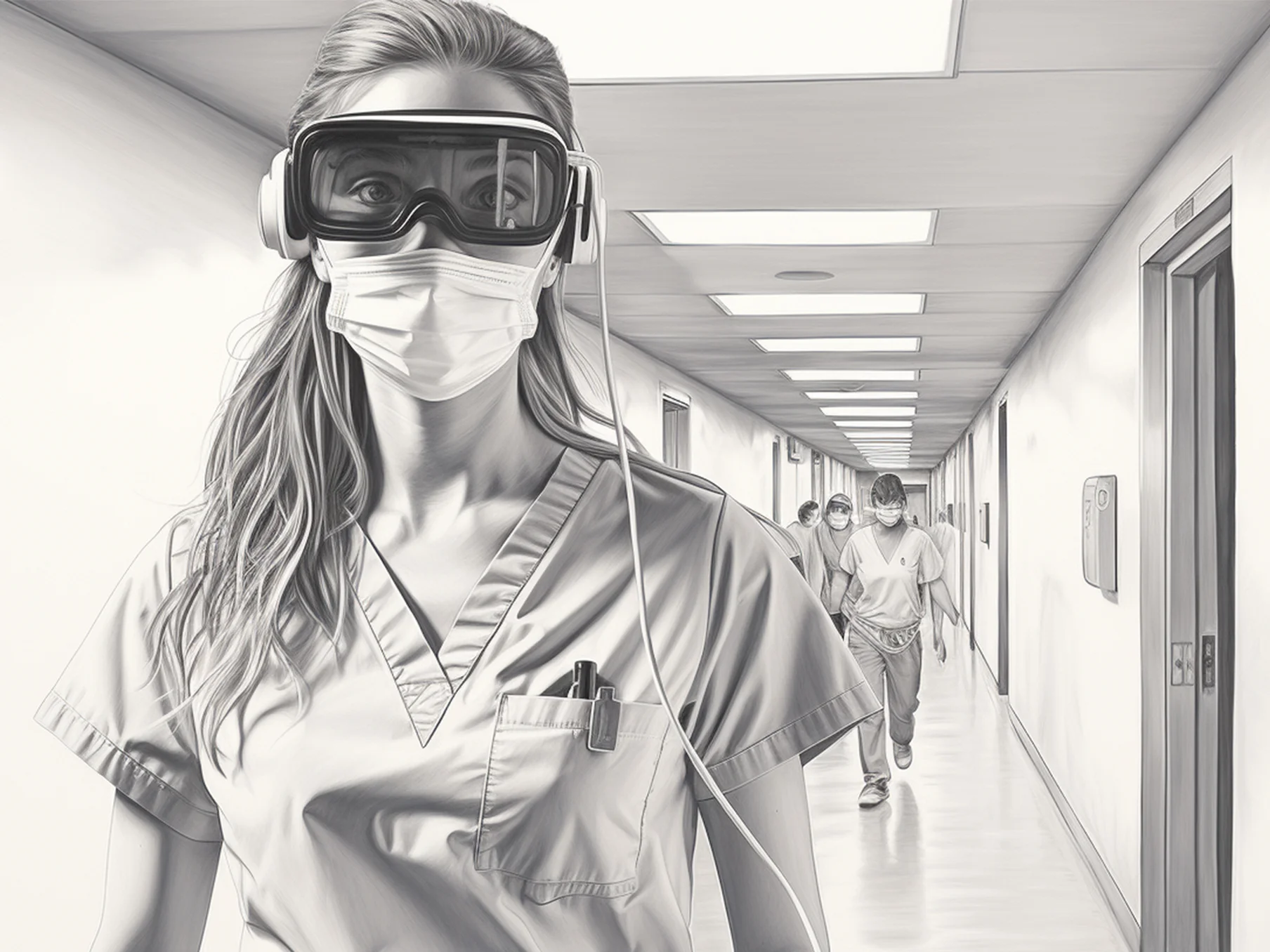
Extended Reality offers fascinating opportunities in the healthcare sector (image AI-generated)
The healthcare sector is increasingly embracing Extended Reality (XR) technologies—spanning Virtual Reality (VR), Augmented Reality (AR), and Mixed Reality (MR)—to transform patient care, medical training, and overall healthcare delivery. XR’s potential is vast, from enhancing surgical precision to offering immersive training for medical professionals, leading to a more effective and empathetic healthcare system.
At headroom, we have conducted an analysis of the emerging XR healthcare market to uncover how these technologies are being applied and what the future might hold. In this report, we present our findings, highlighting key use cases that showcase the potential of XR to reshape healthcare practices.
Immersive Training for Surgeons and Medical Staff
One of the most significant applications of XR in healthcare is in training and education. XR enables the creation of highly detailed, simulated environments where medical professionals can practice complex surgical procedures without the risks associated with real-life operations. This immersive learning environment offers a hands-on experience that is both safe and repeatable, allowing for the refinement of techniques and the reduction of errors.
For instance, VR platforms have been developed where surgeons can rehearse surgeries in a virtual space that mirrors real-world conditions. These simulations can range from standard procedures to highly complex surgeries, providing a comprehensive training tool that adapts to various skill levels. Additionally, AR can be used during actual surgeries to overlay critical information onto a surgeon’s field of vision, enhancing precision and decision-making in real-time.
Improving Patient Outcomes through XR-Assisted Surgeries
Beyond training, XR technologies are actively being integrated into the operating room. Surgeons can utilize AR to enhance their vision during procedures by projecting digital overlays of patient data, such as MRI scans or 3D models of organs, directly onto the surgical field. This allows for more accurate incisions, improved navigation of complex anatomy, and ultimately, better patient outcomes.
Moreover, AR is instrumental in minimally invasive surgeries, where precision is paramount. It can guide surgeons through delicate procedures by providing a real-time, 3D map of the patient’s anatomy, reducing the risk of complications and improving recovery times.
Mental Health and Rehabilitation
XR is also making strides in mental health treatment and rehabilitation. Virtual environments can be tailored to provide exposure therapy for patients with PTSD, phobias, or anxiety disorders. These controlled environments enable patients to confront their fears in a safe and gradual manner, under the supervision of a therapist. This approach has shown promising results in helping patients overcome their mental health challenges.
In rehabilitation, XR can assist in physical therapy by creating engaging and motivating environments for patients recovering from injuries. For example, VR games that require physical movement can be used to improve motor skills and encourage regular exercise, making the rehabilitation process more enjoyable and effective.
Patient Education and Empathy Building
XR is not only a tool for professionals but also for patients. Virtual and augmented reality can be used to educate patients about their conditions, treatment options, and post-operative care. By visualizing their treatment plans or understanding the inner workings of their condition through 3D models, patients can make more informed decisions about their healthcare.
Additionally, XR can be utilized to foster empathy among healthcare providers. VR experiences that simulate the daily struggles of patients with chronic illnesses or disabilities can help healthcare workers better understand and empathize with their patients’ experiences, leading to more compassionate care.
Challenges and Future Directions
While the adoption of XR in healthcare comes with some challenges, such as the need for specialized equipment and the integration into existing systems, these are becoming increasingly manageable as the technology advances and becomes more accessible.
Looking forward, the future of XR in healthcare is bright. As the technology evolves, it is likely to become an integral part of medical practice, enhancing the capabilities of healthcare professionals and improving patient outcomes across the board. From training the next generation of surgeons to providing innovative treatments for mental health, XR is poised to revolutionize the healthcare industry.
In conclusion, Extended Reality in healthcare is not just a futuristic concept but a rapidly emerging reality that holds the potential to transform every aspect of healthcare delivery. By continuing to explore and invest in these technologies, the healthcare industry can create a more efficient, effective, and empathetic system for patients and providers alike.
headroom’s study analyzed 54 XR applications in healthcare, with 30 live, 12 in testing, and 12 in concept. These applications are primarily based in the USA, with most developed by start-ups averaging 56 employees and investments ranging from $30,000 to $82.5 million.