

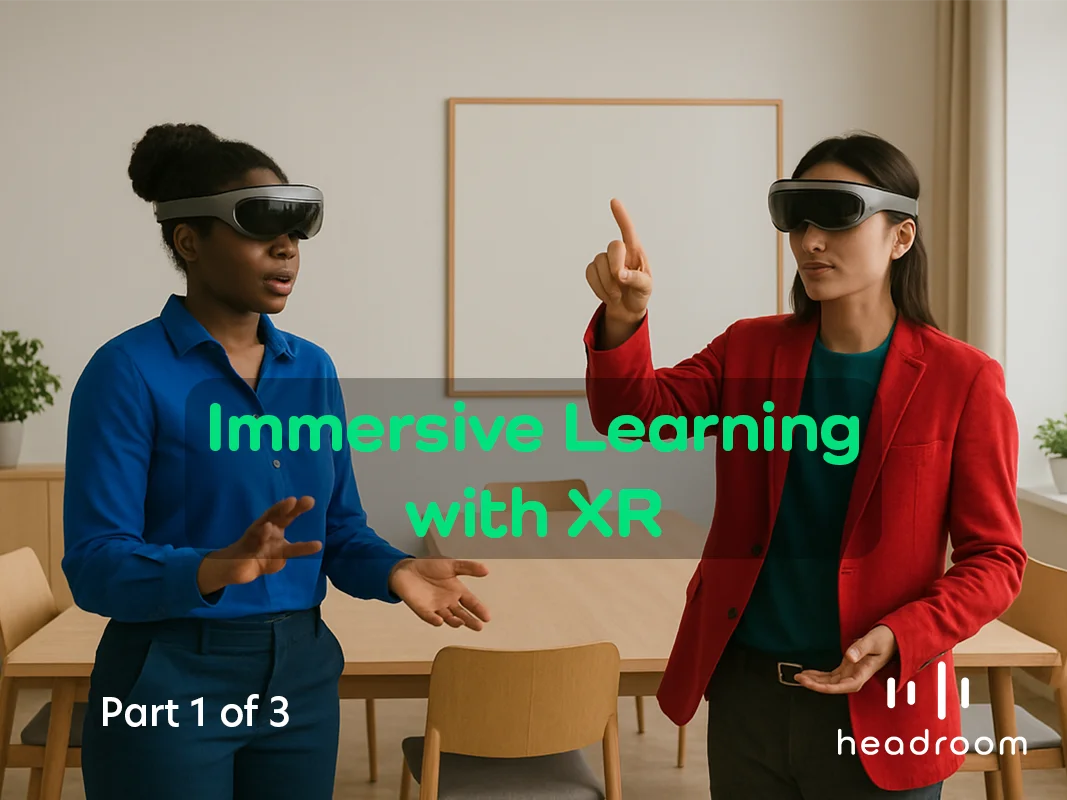
From Onboarding to Lifelong Learning – The XR Employee Journey Explained (Part 1 of 3)
Sean Keogh · 19 Jun 2025 · 2 min read
XR Integration StrategiesWhy XR Is More Than a Cool Demo
The XR employee journey is no longer science fiction—it’s a strategic asset. Across industries, immersive technology is quietly transforming how companies onboard, train, and grow their teams. While traditional L&D tools focus on static content or one-time sessions, XR introduces experience—and with it, retention, engagement, and behaviour change.
This article kicks off our three-part series on immersive learning with XR by mapping out how it supports the entire employee lifecycle—from first-day excitement to long-term growth.
New hires will be significantly more engaged if their day one starts in Virtual Reality
Stage 1: Immersive Onboarding That Actually Onboards
Too many onboarding experiences are passive, clunky, or forgettable. XR flips the script. It places new hires inside a company’s culture—literally.
With virtual tours, gamified introductions, and realistic job simulations, XR onboarding reduces time-to-productivity, builds connection (even remotely), and boosts retention from the start.
Use Cases:
- Virtual office walkthroughs
- Safety training simulations
- Welcome rituals and avatar-led intros
The XR employee journey starts with belonging, not bureaucracy.
Stage 2: Training That Builds Confidence, Not Just Compliance
Next up in the XR employee journey: upskilling. Whether it’s learning machinery, customer service protocols, or complex software, XR provides safe, repeatable, hands-on practice.
Learners make decisions, see outcomes, and get feedback—all without real-world consequences. Compared to click-through eLearning, it’s immersive, emotional, and sticky.
Example Outcomes:
- 75% faster skill acquisition (PwC)
- 30% higher knowledge retention (Accenture)
Stage 3: Leadership Development in Safe-to-Fail Spaces
Training managers and leaders is difficult in static environments. XR opens space for scenario-based roleplaying—handling conflict, public speaking, or negotiation—with realism and replay.
It’s not about replacing coaching. It’s about extending it—into experiences leaders can walk through, reflect on, and refine.
Bonus: Build psychological safety by practicing uncomfortable conversations in private first.
Stage 4: Continuous Learning in the Flow of Work
Learning shouldn’t stop after training. XR enables just-in-time learning moments—contextual help delivered via AR overlays, interactive holograms, or voice interfaces.
Whether it’s a technician referencing a repair sequence or a sales rep practicing a pitch on demand, XR makes learning present, not postponed.
Why the XR Employee Journey Matters Now
The war for talent. The hybrid workplace. The pressure to do more with less. These are not temporary blips—they’re a new baseline. Organisations that embrace the XR employee journey don’t just train better; they adapt faster.
By rethinking learning as a journey powered by experience—not just information—you don’t just develop skills. You build people.
Next week in Part 2: We’ll dive into how to design this journey. From narrative structure to accessibility, discover what separates great immersive learning from gimmicks.
About This Series
This article is part one of our three-part series on immersive learning with XR. In this first piece, we explore how extended reality supports the full employee lifecycle—from onboarding to continuous development. In part two, we dive into what makes modular XR learning truly effective, with design principles that support inclusivity and impact. Finally, part three reveals how to measure the real business value of XR training, with performance metrics and ROI examples from across industries.