

Do one job and do it well: Naer Review
Sean Keogh · 22 May 2024 · 2 min read
Technology ReviewsAt headroom, we look at as many collaborative Virtual Reality tools as we can get our hands on (and are aware of). We particularly like Naer.
At first glance, Naer might appear a little bit too cartoonish to be taken seriously as a workplace tool. As it happens, its slightly naïve appearance is indicative of its greatest strengths. Naer does not look to impress with photorealistic environments or slick avatars. Rather, it concentrates on a particular need and does a brilliant job of fulfilling that need without too many distractions – and presumably while keeping compute-requirements low.
Naer’s one job is to enable teams to work with existing or new Miro boards, bringing these into VR in an intuitive manner. The one requirement in this case is: ensure that the board is refreshed in real time and that the integration is seamless.
This works.
Beyond that, Naer is an excellent execution of how to use the abilities of VR with regard to user interaction. It places the menu right where it should be: On the user’s wrist. The menu itself is delightfully simple and intuitive. If you are manipulating a sticky note and want to change its colour, you will find little buckets of paint – simply select one and the note switches from yellow to blue. If you want to dictate a text into a note, you will find a 3D microphone – simply pick it up, wait for a second for the ring-light to turn red – and then speak. No buttons, no ambiguous icons, just a sensible use of the user’s interface: his or her environment.
This simplicity benefits from the very fact that Naer is – in its current iteration – a single-use application. Menus and other user-interface items will naturally grow more complex when the application itself encompasses more functionality. For now, it is excellent.
Naer manages to include an element of joy in its use. Point at a note on the board, grab it and give a good tug, and it flies over to you. Throw it towards the board and it automatically appends itself. Chuck it over your shoulder and it will be deleted. This philosophy really puts the fun into function – where function comes first but the smile on the user’s face lingers.
All the way through, Naer manages to ensure simplicity. Room-joining codes are sensibly kept at 5 characters – everything beyond that being a serious pain to remember. Once a room has been joined, it appears in the list of recents. Everything feels solid and well thought-through.
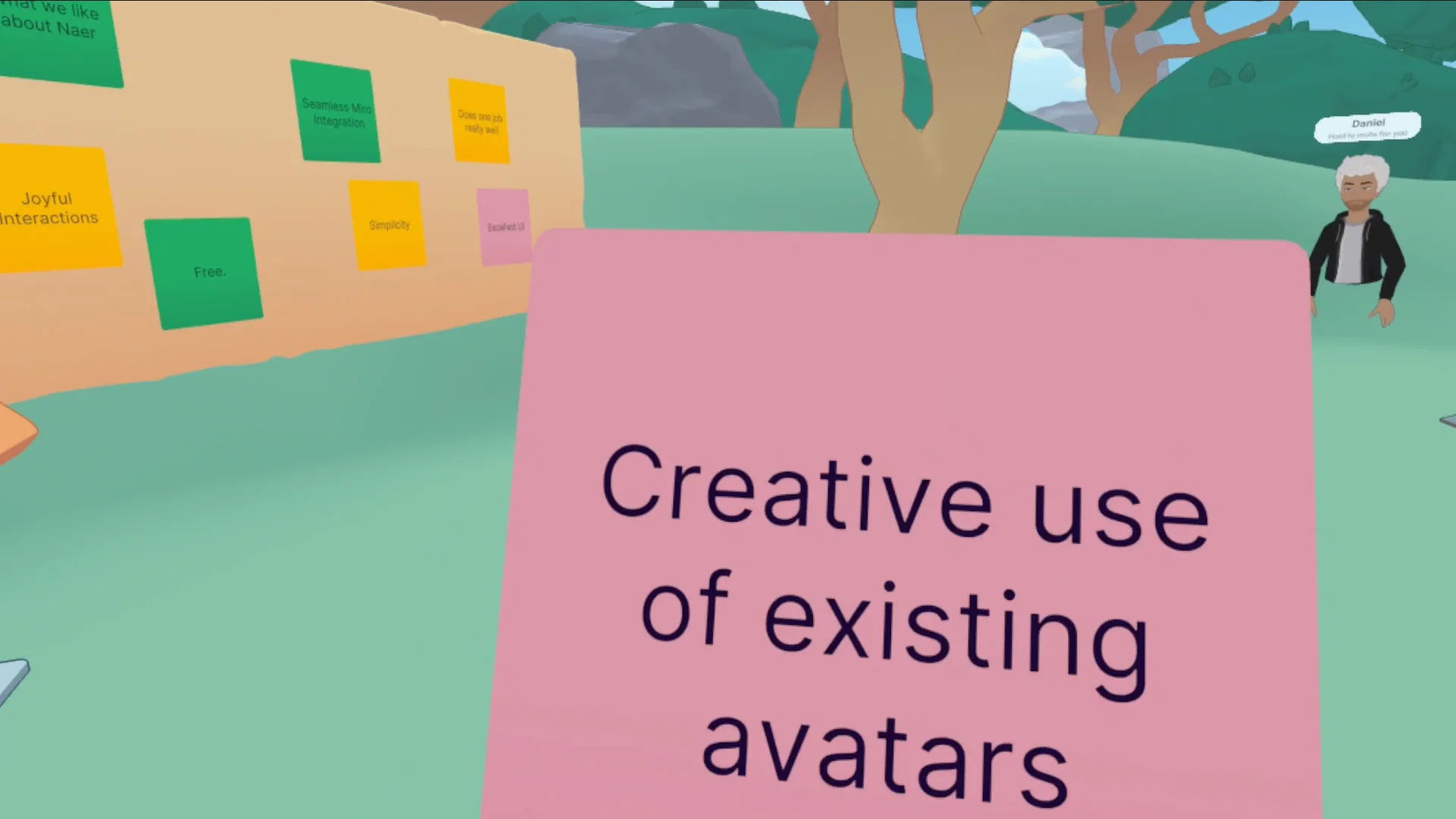
The avatars are really interesting. Naer’s aesthetic is simplistic and blocky while still remaining attractive. They have managed to adapt the existing Meta Avatars to fit into this style – so the participants are just as recognizable as before while the details of each avatar have been reduced. We assume that this, too, might reduce compute power requirements, but even if it is simply to adapt the users to the rest of the environments, it is a really sound choice.
Currently free, Naer is an excellent choice if you wish to work creatively with a team of remote participants while retaining the results in your Miro boards – instantly. We love using it and will be promoting its use for our customers.