

Beyond the Meta Quest: How Steam Frame Raises the Bar for Professional VR
Sean Keogh · 13 Nov 2025 · 5 min read
Technology Reviews
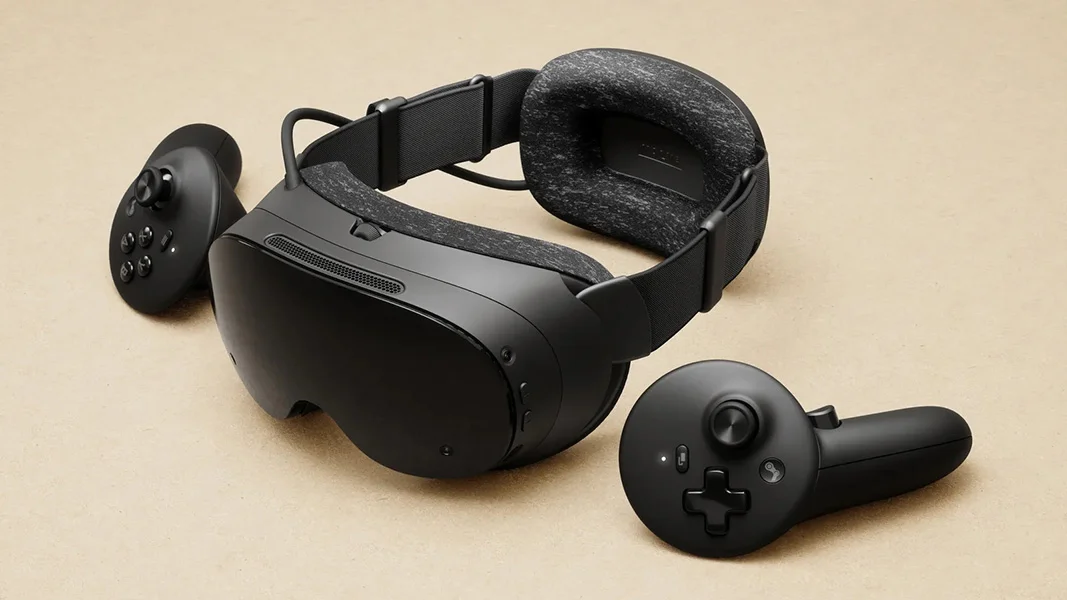
The Steam Frame offers some interesting innovations to a rapidly growing space (Photo: Valve)
For years, corporate teams have been adapting consumer-grade VR headsets for professional use. Meta’s Quest line opened the door – accessible, portable, and increasingly powerful. But with the launch of Valve’s Steam Frame, the conversation shifts from how can we make gaming hardware work for work? to what would a headset built for professional realities look like?
Steam Frame is Valve’s re-entry into the market it helped define, but with a twist. It’s no longer about wired performance or gaming showpieces; it’s about comfort, streaming efficiency, and compatibility – the unglamorous but critical elements that matter when VR becomes a daily tool, not a novelty. In other words, this headset isn’t chasing spectacle. It’s chasing reliability. And that’s exactly what enterprise users have been waiting for.
A note before we start: we haven’t yet had the chance to test the Steam Frame ourselves. Some early reviewers and journalists have, and their initial impressions inform much of what follows — alongside the technical details Valve has released publicly. We’re relying on those sources and Valve’s own statements until we can experience the hardware first-hand.
Designed for People, Not Players
When it comes to long sessions – training, coaching, or remote workshops – comfort beats flash every time. Steam Frame’s modular design shows that Valve has been listening. The headset’s “core” weighs just 185 grams, with a rear-mounted battery strap that distributes weight more naturally. The result is balance, not pressure – a quiet revolution for people who have to wear it for hours.
Compare that to Meta Quest 3: still front-heavy, non-modular, and limited by a fixed battery. Steam Frame’s replaceable system supports extended sessions without interruptions. For teams running back-to-back training or collaborative workshops, that’s not a luxury; it’s a necessity.
Valve also went pragmatic on optics: pancake lenses, 2160 × 2160 per-eye LCDs, and up to 144 Hz refresh rate. It’s not an OLED showpiece, but it’s sharp, fast, and purpose-built for clarity – essential for reading virtual documents or reviewing 3D models in detail.
Streaming as the New Standard
Perhaps the biggest signal from Valve is that streaming, not onboard processing, is now the strategic core of VR. Steam Frame doesn’t hide its priorities. It’s a “streaming-first” headset, designed to connect wirelessly to a PC through a dedicated 6 GHz dongle for ultra-low latency.
Why does that matter for enterprise? Because PC-based VR content – from design simulations to immersive onboarding – is often heavier than mobile chipsets can handle. Steam Frame’s architecture lets those experiences run at full fidelity without the tethers. With foveated streaming – a technology that dynamically adjusts image quality based on where the user’s eyes focus – bandwidth requirements can drop by up to 60%.
For multi-headset environments such as virtual classrooms or shared training labs, that’s a game changer. It makes high-fidelity wireless VR viable at scale – without upgrading every network switch in the building. It’s the kind of efficiency that turns VR from an experiment into infrastructure.
Compatibility That Protects Investment
One of the unsung challenges in enterprise VR is content continuity. Training libraries built for PC VR often rely on x86 architecture — the kind that runs on Windows machines. Steam Frame, powered by an ARM processor, could have been incompatible. Instead, Valve built in Proton, its translation layer that allows x86 applications to run on ARM without redevelopment.
This move quietly bridges one of the biggest divides in immersive tech: legacy content versus new hardware. For organisations that have already invested in VR training or simulation, it means continuity – not redevelopment costs. Meta Quest 3, by contrast, remains locked to its Android ecosystem. While it supports wireless PC streaming via Air Link, it doesn’t offer native compatibility with non-Android VR content. For HR and L&D departments maintaining multi-year libraries, that limitation can make or break adoption.
Real Value Lies in Use, Not Specs
Valve’s specs may excite developers, but for HR and learning professionals, what matters is how those specs translate to outcomes. VR’s promise has always been faster learning, stronger engagement, and more connection.
PwC’s VR Soft Skills Training Effectiveness Study found that employees trained in VR complete courses four times faster and are 275 percent more confident in applying their skills afterwards. Yet adoption lags – partly because hardware hasn’t felt ready for everyday business use.
Steam Frame hints at a future where VR hardware finally aligns with enterprise rhythm: modular, manageable, and sustainable. It’s lighter to wear, easier to maintain, and built for session-after-session use. That makes it more than an upgrade – it’s a tool that lets learning and development teams focus on outcomes, not device logistics.
As Gartner’s 2024 HR survey shows, 41 percent of HR leaders say hybrid work has weakened employee connection to culture. High-fidelity VR collaboration directly addresses that – but only if the hardware supports it. In this light, Steam Frame isn’t competing with Meta Quest 3 on gaming performance; it’s competing on the ability to make connection sustainable.
A Skeptical Note on Infrastructure
There’s one caveat: none of this works without robust connectivity. Foveated streaming assumes a high-performance 6 GHz wireless backbone. Many organisations will need network upgrades before reaping its benefits.
That said, enterprise infrastructure is catching up fast. The shift to Wi-Fi 6E and 7, coupled with private 5G, positions many hybrid offices to support high-bandwidth XR within the next cycle. In the meantime, Valve’s modular design – the option to tether or run standalone – keeps Steam Frame flexible enough to bridge current and future setups.
headroom’s stance is pragmatic: technology is only as transformative as the environment it operates in. Organisations exploring next-generation headsets should pair that investment with an audit of their connectivity and content pipelines.
Raising the Bar — Quietly
The headline innovation of the Steam Frame isn’t spectacle. It’s maturity. Valve has realised that professional VR doesn’t need more wow; it needs fewer reasons to quit halfway through a session.
That insight – subtle but crucial – might mark the real beginning of VR’s professional era. Meta made VR accessible; Valve is making it sustainable.
For HR, L&D, and hybrid-collaboration leaders, that’s the moment to watch. When hardware starts respecting the realities of human use – comfort, compatibility, continuity – VR adoption stops being a pilot project and becomes an everyday tool for connection, learning, and shared experience.